

If you’ve ever stood in front of a rocky slope or gravelly corner and thought, “Nothing is ever going to grow here,” you’re not alone. Rock gardens can look intimidating, but with the right plant choices, they become some of the lowest-maintenance and most beautiful spaces in the yard.
In this guide, I’ll walk you through how I think about rock gardens: matching plants to tough conditions, preparing the site once (not ten times), and then choosing 15 rugged, rock-ready flowers that actually thrive in lean, fast-draining soil. By the end, you’ll know exactly what to plant, where, and how to keep it all looking great with minimal fuss.
I still remember the first rocky bed I planted. I crammed in thirsty cottage-garden perennials that sulked all summer, then quietly disappeared by year two. Once I switched to plants that actually want rocky, well-drained conditions, the same bed turned into a pollinator magnet that basically runs itself. That’s the mindset I want to share with you here.
Why Rock Garden Plant Choice Matters
Rock Gardens Are More Than Just Pretty Stones
Rock gardens are really miniaturized natural landscapes. Think of alpine slopes, canyon walls, and coastal cliffs. The plants that thrive there are adapted to:
- Fast-draining, often rocky soils with very little organic matter.
- Intense sun and temperature swings from day to night.
- Limited water and sometimes fierce wind.
When we match our plant choices to these conditions, rock gardens become practical and stunning. “For more guidance on selecting species that match your site’s conditions, the Royal Horticultural Society offers detailed advice on rock garden plants and their ideal placement. Low-growing perennials knit around rocks, soften hard edges, and add color and movement.
How Harsh Sites Become Low-Maintenance Jewels
I like using rock gardens to solve “problem spots” in the yard—places where lawn never takes or where soil is too thin for thirstier plants. With the right species, those frustrating areas turn into:
- Water-wise plantings that shrug off dry spells.
- Erosion control on slopes, thanks to dense roots and spreading habit.
- Pollinator hubs buzzing with bees, butterflies, and hummingbirds.
Instead of fighting the site with constant watering and fertilizing, you’re working with it. That’s the quiet secret behind a truly smart rock garden.
A Quick Story From My Own Rocky Corner
In one bed along my driveway, the soil is mostly gravel over compacted subsoil. For years I tried adding compost and planting “normal” perennials. They either rotted in spring or crisped in summer.
Once I shifted tactics and planted drought-tolerant rock-garden types—sedums, lavender, salvias, and yarrow—I noticed three big changes: watering dropped to almost nothing, weeds declined, and the bed looked better in August than it did in May. That’s the power of choosing the right plants for rocky places.
How To Prepare A Rock Garden The Smart Way
Check Your Light, Wind, And Drainage
Before you buy a single plant, I suggest spending a few days just observing the site. I like to ask:
- How many hours of direct sun does this spot get? Most rock-garden flowers prefer full sun to light shade.
- Does water sit here after rain or drain quickly? Rocky gardens must drain fast.
- Is it windy or sheltered? Exposed sites favor tough, low growers.
If you find standing water or soggy soil after a storm, that’s a sign to raise the bed or improve drainage before planting.
Build The Right Soil Profile
Rock-garden plants rarely want rich, heavy soil. They thrive in lean, gritty mixes. Here’s how I usually prep a new bed:
- 1. Loosen the existing soil 8–12 inches deep so roots can penetrate. For tips on growing nutrient-rich plants in your garden soil, see our guide on growing homegrown chestnuts—the principles apply to building strong roots for many perennials.
- 2. Mix in mineral material like coarse sand, pea gravel, or small crushed stone (about 25–50% by volume).
- 3. Add just a little compost if your soil is extremely poor—enough to help plants establish, not enough to make it soggy.
- 4. Create gentle mounds and slopes so water naturally drains away from crowns.
Think “mountainside,” not “vegetable bed.” You’re aiming for a substrate that dries quickly after rain.
Place Rocks And Crevices With A Purpose
Rocks are more than decoration—they’re microclimate makers. I often use them to:
- Anchor the design with a few larger boulders, then echo them with smaller stones.
- Create crevices and pockets for trailing and mat-forming plants.
- Provide shade to roots while foliage basks in the sun.
When your site already has rocks, resist the urge to clear them out. Instead, treat them as sculptural focal points and weave plants around and between them for a naturalistic look.
15 Tough Rock Garden Flowers Every Gardener Needs
Early-Season Structure And Spring Color
These first five plants wake up the rock garden early, often before the rest of the yard has even noticed spring has arrived. When you’re ready to select hardy species that thrive in rocky conditions, check out this collection of 10 easy and reliable rock garden plants to jumpstart your planting choices.

1. Columbine (Aquilegia spp.)
Columbine sends up intricate, nodding blooms in shades of red, yellow, blue, and purple, depending on the species. The tubular, spurred flowers are magnets for hummingbirds and other pollinators, and birds later feed on the seeds.
- Light: Full sun to partial shade (more shade in hot climates).
- Height: About 1–3 feet.
- Hardiness: Zones 3–8.
- Best use: Tucking into pockets near boulders, along woodland edges, or in lightly shaded rockeries.
Rocky Mountain blue columbine (Aquilegia coerulea), Western columbine (A. formosa), and Eastern red columbine (A. canadensis) all appreciate well-drained soils and tolerate dry conditions once established.
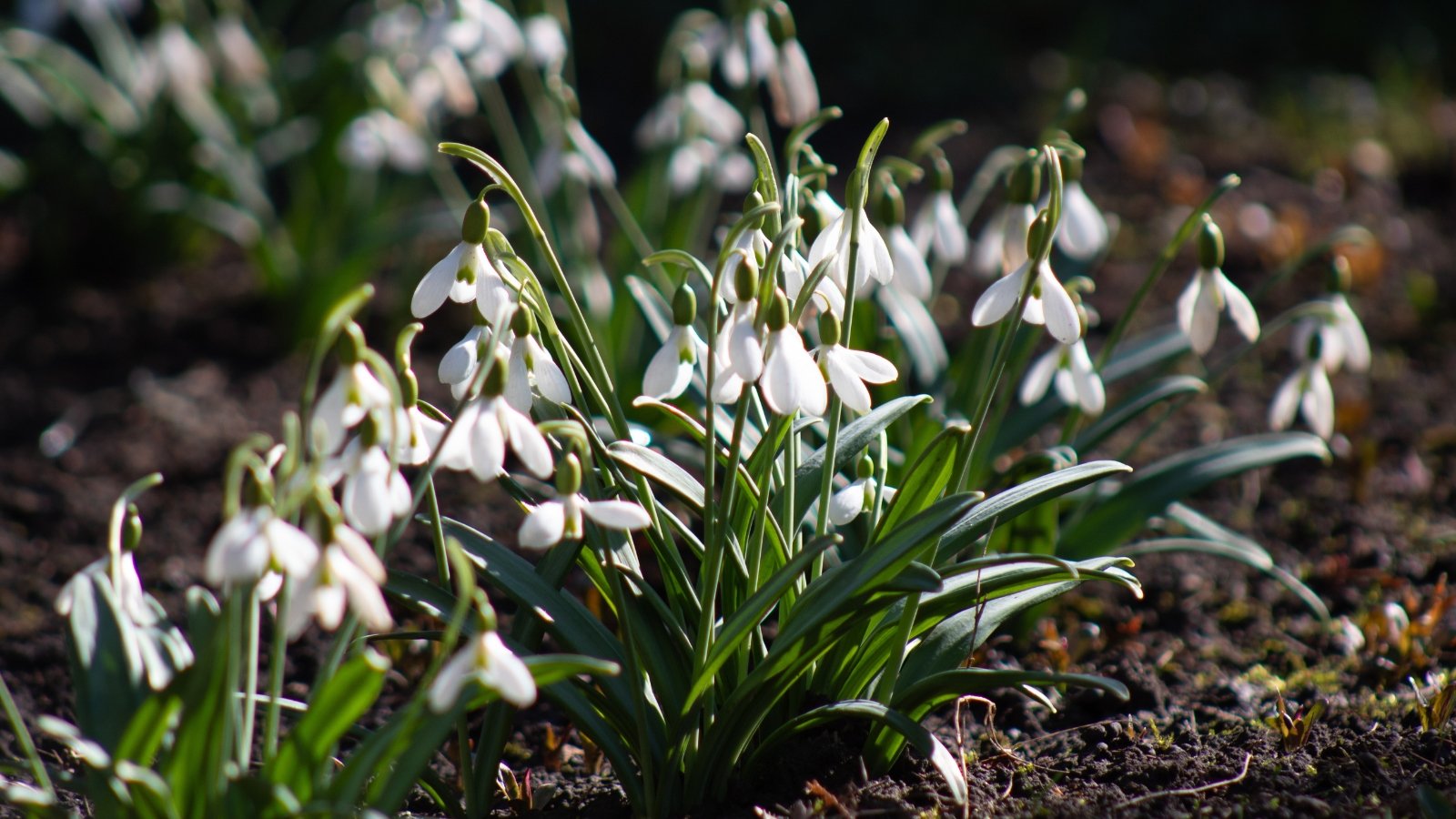
2. Snowdrops (Galanthus spp.)
Snowdrops are the tiny heroes of late winter. Their crisp white, bell-shaped flowers often pop up as early as January, sometimes pushing right through snow.
- Light: Full sun to partial shade.
- Height: Around 12 inches.
- Hardiness: Zones 3–7.
- Best use: Naturalized drifts along paths, at the front of rock beds, or peeking between stones.
I like to plant the bulbs in fall, about 2–3 inches apart and 4 inches deep. They gently spread and can be divided every few years to expand your display.
3. Creeping Phlox (Phlox stolonifera)
Creeping phlox forms a dense, evergreen carpet of needle-like foliage topped with fragrant pincushion blooms in spring. It’s one of my favorite ways to knit rocks and soil together.
- Light: Full sun to partial shade.
- Height: About 3–6 inches.
- Hardiness: Zones 2–8.
- Best use: Rockeries, wall edges, and erosion-prone slopes.
Look for cultivars like ‘Sherwood Purple’ for vigorous growth and strong bloom coverage, or ‘Home Fires’ for a robust pink carpet. Once established, they require very little beyond occasional trimming.

4. Baptisia / False Indigo (Baptisia australis)
Baptisia brings sturdy spikes of blue flowers in late spring to early summer, followed by dark seed pods that rattle in the wind and add winter interest. The blue-green foliage stays attractive all season.
- Light: Full sun to partial shade.
- Height: About 3–4 feet.
- Hardiness: Zones 3–9.
- Best use: As a structural anchor near the back of a rock garden.
Native to central and eastern North America, Baptisia grows naturally in prairies and open woodlands, handling average to dry soils with ease. It spends its first year building deep taproots, then really hits its stride in year two and beyond.

5. Eastern Bluestar (Amsonia tabernaemontana)
Amsonia, or eastern bluestar, shines in late spring with clusters of starry, periwinkle-blue flowers. The narrow, willowy leaves turn a gorgeous golden yellow in fall, giving you multi-season interest.
- Light: Full sun to partial shade.
- Height: About 2–3 feet.
- Hardiness: Zones 3–9.
- Best use: Mid-border clumps that glow against stone and gravel.
The cultivar ‘Storm Cloud’ has nearly black emerging stems and a dense, rounded habit. Amsonia is drought-tolerant, deer-resistant, and handles heat and humidity once established.
Sun-Loving, Drought-Tough Workhorses
These five plants are my go-tos for the hottest, driest, most exposed rock garden spots.

6. Stonecrop (Sedum, Hylotelephium spp.)
Stonecrop offers succulent foliage and late-season flowers that carry your rock garden into fall. Forms range from tight groundcovers to upright clumps with broad leaves.
- Light: Full sun to partial shade.
- Height: About 3–24 inches, depending on species.
- Hardiness: Zones 3–9.
- Best use: Filling crevices, topping walls, and edging paths.
Try Sedum ‘Yellow Brick Road’ for a low, spreading mat of deep green foliage and small yellow blooms, or Hylotelephium ‘Autumn Fire’ for sturdy, rosy flower heads that feed pollinators and birds well into winter.
7. Lavender (Lavandula spp.)
Lavender is practically made for rock gardens, with its silvery foliage, fragrant purple spikes, and love of quick-draining soil. It dislikes wet feet but thrives in lean, rocky mixes.
- Light: Full sun.
- Height: Up to about 3 feet, depending on variety.
- Hardiness: Zones 5–8 for many types.
- Best use: Sunny banks, raised beds, and along gravel paths.
In cold climates, look for hardy English types like Lavandula angustifolia ‘Munstead’. In humid regions, choose disease-resistant varieties like ‘Phenomenal’ and water only when the soil has dried out. If you want to try drought-tolerant plants in containers or small raised beds, check out our guide on how to grow foxtail fern in pots, which shares tips easily adapted for rock garden plants.
8. Russian Sage (Salvia yangii)
Russian sage is a champion for xeric sites—hot, dry, and sunny. It sends up clouds of purple blooms on silvery stems, creating a soft haze of color from summer into fall.
- Light: Full sun.
- Height: About 2–4 feet.
- Hardiness: Zones 5–9.
- Best use: Back-of-bed drifts for movement and pollinator appeal.
In humid climates, look for disease-resistant selections like ‘Denim ‘n Lace’ or ‘Crazy Blue’ and give them plenty of air circulation to prevent fungal issues.
9. Santolina / Lavender Cotton (Santolina chamaecyparissus)
Santolina is an Old World herb with aromatic, finely cut, silvery foliage and masses of golden-yellow button flowers in summer. It’s perfectly at home in coastal, windy, and hot exposures.
- Light: Full sun.
- Height: About 1–2 feet.
- Hardiness: Zones 6–9.
- Best use: As a mounding groundcover or edging plant in dry rock gardens.
It tolerates sandy, clay, and rocky soils as long as drainage is sharp. High humidity can invite fungal disease, so I space plants generously for good airflow.

10. Yarrow (Achillea millefolium)
Yarrow is another easygoing native-style perennial with feathery foliage and broad flower heads that hover above the clump. Wild types are typically milky white, but cultivars range from soft pastels to terracotta tones.
- Light: Full sun.
- Height: About 1–3 feet.
- Hardiness: Zones 3–9.
- Best use: Sunny rock beds and dry meadows where you want butterflies and minimal upkeep.
Yarrow laughs at summer heat and poor soils, needing little more than sun and drainage to thrive. Deadheading can extend bloom, but I often leave later flowers for pollinators.
Pollinator Magnets And Problem-Solvers
These last five plants pull extra duty as pollinator magnets, erosion control, or living groundcovers.

11. Scarlet Sage (Salvia coccinea)
Scarlet sage is a heat- and drought-tolerant North American native that produces bright red spikes from early summer right up to frost. Hummingbirds adore its tubular blooms.
- Light: Full sun to partial shade.
- Height: About 2–3 feet.
- Hardiness: Perennial in Zones 8–10; annual elsewhere.
- Best use: Seasonal color in hot, exposed beds and pollinator patches.
In colder zones, I grow it as a summer annual. Deadheading encourages rebloom, and in Zones 6 and up it often self-seeds for a naturalized look.

12. Mexican Bush Sage (Salvia leucantha)
Mexican bush sage doesn’t flinch at heat, lean soil, or drought. In late summer and fall, it sends out long, arching stems lined with velvety purple and white blooms.
- Light: Full sun to partial shade.
- Height: About 2–3 feet.
- Hardiness: Zones 7–10.
- Best use: Late-season color in dry borders and large rock gardens.
Fuzzy, aromatic foliage is handsome even out of bloom. Look for cultivars like ‘Danielle’s Dream’ (pink flowers), ‘All Purple’ (rich purple), or compact ‘Santa Barbara’ for smaller spaces.
13. Lupine (Lupinus spp.)
Lupine produces showy spires of pea-like flowers in blue, purple, pink, white, and yellow. As legumes, they also fix nitrogen, helping to improve soil over time.
- Light: Full sun to partial shade.
- Height: About 1–5 feet, depending on species.
- Hardiness: Zones 3–8.
- Best use: Mid-to-back-of-bed accents and meadow-style plantings.
Eastern native Lupinus perennis bears purple and white blooms, while L. polyphyllus is famous for its tall violet spikes. In some regions it can escape cultivation, so check local guidance before planting.

14. Blue Flax (Linum lewisii)
Blue flax brings airy stems topped with multiple, sky-blue flowers that sway in the breeze. Each blossom is short-lived, but plants bloom over an extended period in early summer.
- Light: Full sun to partial shade.
- Height: About 1–3 feet.
- Hardiness: Zones 4–8.
- Best use: Slopes, disturbed spots, and naturalistic rock gardens.
Named for explorer Meriwether Lewis, this species grows across a wide range of elevations and tolerates dry, rocky, and disturbed soils very well.
15. Lance Selfheal (Prunella vulgaris subsp. lanceolata)
Lance selfheal is a rugged wildflower native across much of the Northern Hemisphere. Purple flower spikes attract pollinators and serve as a host resource for the clouded sulfur butterfly.
- Light: Full sun to partial shade.
- Height: About 4–20 inches.
- Hardiness: Zones 3–9.
- Best use: Slopes, erosion-prone areas, or as a low-input turf alternative.
It has a bit of a weedy streak and can spread aggressively, so I reserve it for contained beds or tough areas where I want a living green cover that tolerates some foot traffic and even mowing.
Troubleshooting And Caring For Rock Garden Plants
Watering Smart In Rocky Beds
Most of these plants prefer you to underwater rather than overwater. I usually follow a simple pattern:
- New plantings: Water deeply once or twice a week for the first season, depending on rainfall.
- Established plants: Water only during prolonged dry spells, focusing on slow, deep soakings.
- Avoid daily sprinkling: It encourages shallow roots and can promote disease.
If foliage starts to yellow from the base or crowns turn mushy, that’s often a sign of too much water or poor drainage rather than drought.
Feeding, Mulching, And Grooming
Rock-garden perennials are used to lean soils, so I rarely fertilize. When I do, it’s a light application of a balanced organic feed in early spring. Overfeeding can produce lush, floppy growth that doesn’t suit rocky conditions.
- Mulch with gravel or small stone rather than bark to keep crowns dry.
- Deadhead rebloomers like scarlet sage and lavender to encourage more flowers.
- Leave some seed heads on sedum, yarrow, and Baptisia for winter interest and bird food.
A quick seasonal tidy—snipping back dead stems in late winter—is usually enough to keep these plants looking sharp.
When Plants Struggle: Diagnose And Adjust
Even tough plants can falter if something is off. I like to troubleshoot by checking:
- Too much shade: Long, stretchy growth and few flowers suggest you need a sunnier spot for that species.
- Too much moisture: Rotting crowns, fungal spots, or constant mildew point to poor drainage or overwatering.
- Competition from weeds: Thin, weak clumps may be crowded by turf or invasive roots.
With rock-garden plants, a simple move—like shifting to a sunnier, drier pocket or raising a plant onto a slight mound—often makes all the difference.
Adopting A Smart Rock Garden Mindset
Observe First, Plant Second
I’ve learned that the most successful rock gardens come from careful observation, not impulse buying. Spend a season watching where snow melts first, where the soil dries fastest, and where you naturally walk or sit. If you want tips on evaluating your garden microclimates and choosing plants accordingly, this guide on selecting plants for a rock garden provides helpful insights.
Then choose plants that fit those microclimates, rather than forcing one design everywhere. You’ll save money, water, and a lot of frustration.
Mix Beauty With Habitat
Every plant on this list does double duty: it’s beautiful and it supports pollinators or wildlife. “For more inspiration on designing a garden that attracts pollinators while staying low-maintenance, explore our low-maintenance pollinator garden guide. Hummingbirds on columbine and salvias, bees on yarrow and sedum, butterflies on selfheal and lupine—your rock garden can be a small but mighty habitat.
When you choose plants with ecological value, you get a garden that feels alive, not just decorated.
Give Your Rock Garden Time To Settle
Rock gardens often look a bit sparse in year one. By year two and three, plants knit together, spill over rocks, and start to look truly naturalistic. I try to plan for the future size of each clump and resist the urge to overplant.
If you stay patient and focus on the right species, the garden gradually shifts from “newly planted” to “this has always been here.” That’s the real magic.
Quick Rock Garden Checklist And Summary
At-A-Glance Rock Garden Plant Table
Use this table as a quick reference when you’re planning or shopping.
| Plant | Height (Approx.) | Zones | Light | Best Role In Rock Garden |
|---|---|---|---|---|
| Columbine (Aquilegia spp.) | 1–3 ft | 3–8 | Full sun–part shade | Spring color, pollinator magnet |
| Snowdrops (Galanthus spp.) | Up to 1 ft | 3–7 | Full sun–part shade | Late winter bulbs between stones |
| Stonecrop (Sedum spp.) | 3–24 in | 3–9 | Full sun–part shade | Groundcover, late-season color |
| Lavender (Lavandula spp.) | Up to 3 ft | 5–8 | Full sun | Fragrance, structure, pollinators |
| Russian Sage (Salvia yangii) | 2–4 ft | 5–9 | Full sun | Xeric backdrop, long bloom |
| Lupine (Lupinus spp.) | 1–5 ft | 3–8 | Full sun–part shade | Vertical accent, soil improvement |
| Yarrow (Achillea millefolium) | 1–3 ft | 3–9 | Full sun | Heat-tolerant pollinator buffet |
| Amsonia (A. tabernaemontana) | 2–3 ft | 3–9 | Full sun–part shade | Spring bloom, fall foliage color |
5-Step Rock Garden Success Checklist
Before you plant, I like to run through this short checklist:
- 1. Assess the site: Note sun exposure, drainage, and wind so you can choose plants accordingly.
- 2. Improve drainage: Loosen soil and mix in gravel or coarse sand, especially in heavy or compacted spots.
- 3. Place rocks thoughtfully: Use larger stones as anchors and create crevices for trailers and groundcovers.
- 4. Choose tough, zone-appropriate plants: Start with the 15 options in this article and match them to your conditions.
- 5. Water to establish, then ease off: Deep water in year one, then let your rock-garden plants lean on their natural toughness.
Share Your Rock Garden Wins
I hope this walkthrough helps you stop guessing and start planting with confidence in your rocky spaces. If you’ve tried any of these 15 flowers—or discovered your own favorites for tough spots—I’d love to hear about it.
Head over to Plant Care Dairy and share your rock garden questions, successes, and lessons learned in the comments. Your experience might be exactly what another gardener needs to finally turn that stubborn rocky patch into a thriving mini-landscape.
Disclaimer: This article is for informational purposes only and is based on general growing conditions and personal experience. Always consider your local climate, soil, and regulations, and consult regional experts or extension services for specific advice before planting or making significant changes to your landscape.