
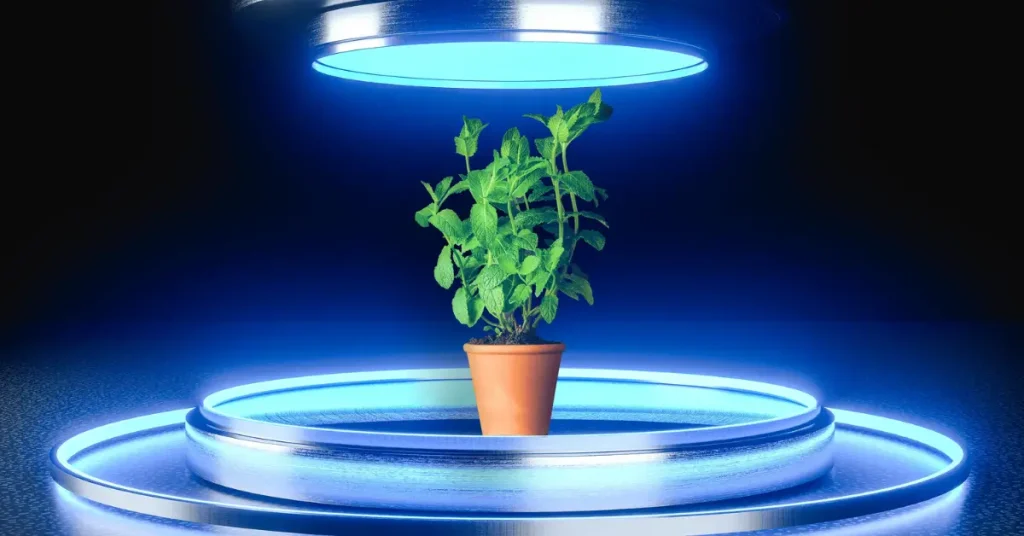
I’ve lost count of how many times I’ve seen a “miracle LED” promise faster growth just by cranking up the blue. Truth? Blue light is powerful—but it’s not magic. It sits in the 400–500 nm range and tells plants how to shape up: open stomata, build sturdier leaves, and stay compact instead of stretching. Use it right and seedlings stand like little soldiers. Use it wrong and you stall biomass or stress a crop you meant to help.
When I test light recipes, I don’t start with watts; I start with goals. Do you want tighter internodes on basil? Tougher, thicker lettuce leaves? Or do you need speed and mass on tomatoes? Blue can boost photosynthetic control and leaf quality, but it won’t replace the red that drives bulk growth—and too much blue can actually slow the expansion you’re hoping for.
If you’ve ever watched seedlings get leggy on a windowsill, you’ve already seen what “too little blue” looks like. The fix isn’t buying the brightest panel—it’s balancing spectrum, stage, and intensity. A small nudge in blue during early vegetative growth can clean up form, reduce flop, and make the rest of your lighting work harder.
I’ll break all of that down without fluff—what to dial in, what to avoid, and how to read the plant’s response in real time. Before we dive in, tell me: what’s your crop and what does “faster, healthier” mean for you—more mass, tighter form, or better flavor?
Why the Colour of Light Really Matters
What “Blue Light” Means in the Plant World
If you’ve ever switched on a grow light and wondered why some LEDs glow that deep bluish hue, you’re already looking at one of the most influential parts of the spectrum. Blue light sits roughly between 400 and 500 nanometres, and it’s the first signal a plant reads when the day begins.
Unlike red or green light, which mainly fuel photosynthesis, blue light acts as a messenger. It tells plants how to grow — whether to stretch tall, stay compact, or unfold new leaves. When that wavelength hits a leaf’s surface, it signals the plant to open its pores, build thicker tissues, and strengthen cell walls to handle bright conditions.
If you grow indoors under LEDs, this wavelength becomes even more critical. Without enough blue light, seedlings often turn leggy—tall, thin, and weak. Too much, and they can stop expanding altogether. The key lies in balance — knowing when and how to let that cool tone do its quiet work.
A quick reference for your setup:
- Blue (400–500 nm): Controls leaf structure, stomatal activity, and plant compactness.
- Red (600–700 nm): Drives photosynthesis and flowering.
- Green (500–600 nm): Helps light reach deeper canopy layers.
That’s why experienced growers never talk about “light” in general — they talk about spectra.
How Plants Detect and Respond to Blue Light
When blue light lands on a leaf, it doesn’t just shine — it communicates. Plants sense it through photoreceptors called cryptochromes and phototropins. Think of them as tiny sensors inside leaf cells, constantly decoding light signals.
Here’s how they respond:
- Cryptochromes help regulate the plant’s internal clock — when to grow, rest, or prepare for night.
- Phototropins control direction — they’re the reason stems bend toward sunlight or a window.
Once activated, these receptors trigger a chain of growth reactions:
- Cells tighten, reducing unnecessary elongation.
- Stomata (tiny pores) open to allow better gas exchange.
- Energy shifts into building stronger stems and thicker leaves.
This system, detailed in a peer-reviewed study by the National Library of Medicine, shows how precisely plants read blue light cues — and why this wavelength is essential for shaping healthy growth early on. If you’d like to dig deeper into how every organ of a plant contributes to that response, take a look at our guide on understanding the essential parts of plants; it gives you a full picture of how roots, stems, and leaves coordinate under changing light conditions.
The Core Effects of Blue Light on Plant Morphology & Physiology

How Blue Light Influences Leaf Shape, Stem Thickness & Plant Height
Over the years, I’ve seen one pattern repeat: plants under blue-rich light always look sturdier. They’re shorter, their leaves are thicker, and their stems don’t flop over easily.
- Compact plant structure with stronger internodes.
- Improved leaf density and canopy formation.
- Better overall resilience against wind or transplant stress.
Essentially, blue light tones the “muscle” of the plant — keeping growth controlled and balanced. For you, that means fewer weak seedlings and sturdier plants that handle handling or movement better.
Blue Light’s Role in Photosynthesis, Stomatal Conductance & Internal Metabolism
Here’s where the science meets the visible change. Blue light directly influences how plants breathe and feed. It boosts stomatal conductance — the opening and closing of pores — improving the exchange of carbon dioxide, water, and oxygen.
For a closer look at this invisible process, you can read our detailed feature on how plants breathe; it explains exactly what happens inside those tiny pores when light and air meet.
In simple terms:
- Leaves under blue light photosynthesise more efficiently.
- Chlorophyll content increases, deepening leaf colour.
- Nutrient circulation speeds up, supporting faster tissue repair and new growth.
If you’ve ever noticed how leaves grown under cooler-toned LEDs feel slightly thicker and glossier — that’s not coincidence. That’s metabolism working at full speed.
How Blue Light Interacts with Other Colours in the Spectrum
Here’s what most guides miss: plants don’t grow under blue light alone. Real growth happens in a spectrum balance. Blue controls form, red drives flowering and biomass, and both together create optimal energy use.
Here’s how you can adjust your mix:
- Seedling/vegetative stage: More blue → stronger structure.
- Transition stage: Even mix → steady development.
- Flowering/fruiting stage: Higher red → larger yield, with a touch of blue to keep strength.
Modern LED setups allow you to fine-tune these ratios for every phase — something sunlight does naturally. Even a small tweak in your blue intensity can transform a weak, stretched plant into a compact, thriving one ready for heavy yield.
Practical Benefits: What Blue Light Gives You in Plant Growth
Stronger, Healthier Stems & Leaves
When I first started experimenting with light setups, I assumed brighter meant better. But what I learned over time is that it’s the right wavelength — not the most intense one — that makes plants strong. Blue light builds structure. It encourages shorter internodes, thicker stems, and firm leaves that can handle airflow or handling without collapsing.
If you’ve ever grown herbs or greens indoors, you know how frustrating it is to see them stretch thin and bend toward the light. That “leggy” look usually means your spectrum is too warm or lacking blue. A few hours of blue-rich light each day helps plants stand upright, balance moisture, and stay compact — exactly what indoor growers want.
You’ll notice the difference fast: leaves look more vibrant, feel tougher, and hold shape even when watered heavily. In short, blue light trains your plants to grow strong first, big later.
Improved Nutritional and Quality Traits
What most people overlook is that blue light changes not just how plants look — but what’s inside them. Several studies, including those from agricultural science departments, show that plants grown under blue light develop:
- Higher antioxidant levels, including flavonoids and phenolic compounds.
- Deeper green pigmentation, linked to increased chlorophyll concentration.
- Better nutrient density, especially in leafy greens and microgreens.
If you sell produce or simply want healthier home-grown greens, adding moderate blue light during growth can literally make your harvest more valuable per leaf. how the garden food chain keeps your plants alive and thriving naturallyTo get the most out of those nutrient-dense harvests, it also helps to understand ; the microscopic life beneath the soil works hand in hand with light to power healthy, balanced growth.
Shaping Growth for Specific Uses
Not every grower has the same goal. Some want showy ornamentals; others want fast-cycling leafy crops. Blue light gives you the flexibility to shape growth to your exact purpose.
Here’s how it helps:
- Seedlings: Extra blue early on prevents stretching, giving them strong root-to-shoot balance.
- Ornamental plants: Maintains compact, aesthetic form for better retail appearance.
- Leafy vegetables: Produces denser foliage and more uniform heads.
So, whether you’re cultivating basil for flavour, pansies for display, or lettuce for market shelves, tuning your blue ratio gives you control over form and function — something no fertilizer can do.
Common Misunderstandings & Risks of Blue Light

Myth: More Blue Always = Faster Growth
One of the biggest misconceptions out there is that cranking up blue automatically speeds up plant growth. It doesn’t. In fact, too much blue can slow expansion by signalling the plant to stay compact and conserve energy.
As highlighted by CW Energy USA, plants exposed to excessive blue may become dense and short, but their overall biomass can drop. That’s because blue light focuses on quality over quantity — improving structure at the expense of fast height gain.
So if your plants look healthy but smaller than expected, it might not be nutrient deficiency — it could just be too much blue.
Risk of Too Much Blue or the Wrong Ratio
Every spectrum needs balance. Overexposure to blue or poor ratio management (compared with red and green) can cause:
- Reduced leaf area — limiting photosynthetic surface.
- Lower yields — especially in fruiting crops.
- Stressed foliage with curling or colour shifts.
Remember: blue drives discipline in a plant’s form, while red fuels growth. The goal isn’t dominance — it’s harmony. A ratio of about 20–30% blue light in your LED setup is often a good starting point for vegetative stages, but always observe your crop’s feedback.
Species-Specific Responses & Environment Dependence
Every plant tells a slightly different story. Tomatoes and peppers, for instance, prefer more red during flowering; leafy greens thrive under higher blue. Even within the same family, environmental context changes everything — humidity, light intensity, and reflective surfaces all play a role.
Indoor lettuce, basil, and kale respond positively to strong blue input, while fruiting plants may show reduced yield if the ratio isn’t balanced. The takeaway? No universal recipe exists. What works in one grow tent may not work in your greenhouse.
Treat blue light as a variable to fine-tune, not a fixed rule.
How to Use Blue Light for Faster, Healthier Plant Growth: Step by Step

Determine Your Crop, Purpose & Growth Stage
Start by asking yourself: What am I growing — and why?
- For seedlings, aim for strong early structure.
- For leafy crops, focus on dense, even foliage.
- For fruiting or flowering plants, keep blue moderate during the bloom phase.
Knowing your crop’s goal makes adjusting blue far simpler and prevents “trial-and-error fatigue.”
Choose the Right Blue-Light Intensity and Spectrum
Not all blue light is equal. You’re looking for wavelengths between 400–500 nm, typically delivered by cool-white or blue LEDs. Here’s how to balance intensity:
- Seedlings: 25–30% blue light
- Vegetative phase: 15–25%
- Flowering/fruiting: 5–15%
Lower ratios at later stages help maintain productivity while preserving structural integrity. Always test small batches before scaling across a full setup.
Integrate with the Rest of the Lighting Spectrum & Environment
Your plants don’t live under blue light alone — they live under a mix. Combine blue with red, far-red, and a bit of green for even canopy penetration and full-spectrum growth.
In greenhouses, natural sunlight already provides balance. Indoors, make sure your artificial setup includes some warmer wavelengths to complement blue’s structural benefits. A well-designed LED panel or spectrum controller can save you countless hours of guesswork.
Also, keep temperature and humidity in check; blue light often increases transpiration, so hydration must keep up.
Monitor Results: Shape, Biomass & Leaf Quality Metrics
Finally, track progress the same way a grow scientist would. Note changes in:
- Stem diameter (thicker = good structure)
- Leaf area index (too small = too much blue)
- Colour intensity (richer greens usually signal good chlorophyll production)
- Yield weight at harvest
Use your camera or growth journal weekly. If plants look healthy but slow, ease the blue slightly. If they’re tall and floppy, increase it a notch.
Blue light isn’t about perfection — it’s about tuning your environment to what your plants tell you. Once you get that rhythm right, you’ll see the difference not just in how they grow, but in how alive your grow space feels.
Evidence & Research Highlights Worth Knowing
Blue light has been under the microscope for decades, but only in recent years have scientists begun to map out how deeply it affects plant physiology. One of the most cited findings comes from research published on PubMed Central, which confirms that blue light increases stomatal conductance and photosynthetic capacity in several plant species.
In that study, plants exposed to moderate levels of blue wavelengths developed:
- Higher chlorophyll content (leading to deeper green foliage).
- Faster gas exchange rates, improving CO₂ uptake.
- More efficient photosynthesis under variable lighting conditions.
This essentially means that blue light fine-tunes how plants “breathe” — making their internal systems more adaptable and resilient. The research adds weight to what many growers observe anecdotally: when blue light is balanced, plants are both stronger and more efficient.
Emerging Insights: Blue Light and Stress Tolerance
What’s truly fascinating is how blue light affects plants under stress — something newer research has started exploring. Studies in plant photobiology now show that blue wavelengths help plants cope with environmental stress, like sudden changes in temperature, fluctuating light, or drought conditions.
Here’s what’s been observed in recent trials:
- Improved photoprotection: Blue light enhances a plant’s natural sunscreen pigments, reducing damage from strong light bursts.
- Better water regulation: It stabilises stomatal control, helping plants lose less moisture during dry spells.
- Adaptive signalling: Plants under mixed blue-red light react faster to stress, recovering more efficiently after shock.
Frontiers in Plant Science researchers note that this effect is tied to how blue light triggers reactive oxygen species (ROS) signalling, which activates the plant’s built-in defense mechanisms. In short — it helps plants prepare for stress before it even happens.
What Still Remains Unknown
Even with all this data, scientists still don’t fully agree on the ideal blue-to-red ratio for every crop. Results vary not just between species but also across environments.
What we still need more research on:
- Crop-specific thresholds: Lettuce may love 25% blue, but tomatoes might slow down at the same level.
- Long-term metabolic effects: Does prolonged blue exposure change nutrient profiles permanently?
- Natural vs artificial light balance: How do plants integrate blue from sunlight and LEDs together?
Understanding these gaps is what separates informed growers from guesswork. The truth is, plant light science is still evolving — and that’s a good thing. It means there’s room for experimentation and discovery in your own grow setup.
Quick Reference Checklist & Best Practices
Pre-Use Checklist
Before you change your lighting setup or buy a new LED panel, pause and verify a few things first:
- Crop type: Leafy greens, herbs, or fruiting plants all respond differently.
- Growth stage: Seedlings need more blue; flowering plants need more red.
- Available spectrum: Know your panel’s wavelength output (400–500 nm range for blue).
- Environment: Temperature, humidity, and reflection affect how light behaves.
- Monitoring plan: Track leaf thickness, colour tone, and growth rate weekly.
Doing this groundwork keeps you from overcorrecting or wasting energy.
Do’s & Don’ts
Do:
- Include blue light early in the vegetative stage for better form and leaf structure.
- Adjust blue intensity gradually — sudden spikes can stress plants.
- Keep your LEDs clean and calibrated to maintain accurate wavelength delivery.
Don’t:
- Assume blue light alone replaces red light — you’ll limit biomass and flowering.
- Run all-blue lighting 24/7; plants need dark cycles to rest.
- Ignore leaf feedback — curling, bronzing, or slowed growth are warning signs.
Balance and observation will always outperform rigid rules.
Troubleshooting Common Issues
Even seasoned growers hit snags. Here’s how to decode what your plants might be telling you:
| Symptom | Possible Cause | Quick Fix |
|---|---|---|
| Plants too compact, slow growth | Too much blue or not enough red | Reduce blue ratio by 5–10%, extend photoperiod slightly |
| Leaves curling or bronzing | Overexposure to blue, heat stress | Raise light distance or lower intensity |
| Pale or weak leaves | Insufficient blue or nutrient deficiency | Increase blue ratio modestly, check nutrient mix |
| Uneven growth between plants | Poor light distribution | Reposition panels for even coverage |
When you track and adjust systematically, you start to see patterns — and that’s where mastery begins.
Blue light isn’t just about faster growth; it’s about smarter growth. Once you understand its rhythm, you can shape plants that are not only beautiful but biologically stronger.
What This Means for You (Grower / Enthusiast)
How You Can Apply This Tomorrow
You don’t need to rebuild your whole setup to see the difference blue light makes — just start small and intentional.
Here’s how you can put this knowledge to work right away:
- Check your current light ratio. If you’re using full-spectrum LEDs, look for their blue-light percentage (usually between 15–30%).
- Adjust your timing. Add an hour or two of blue-rich light during the early part of your plant’s day. It helps seedlings stay compact and strengthens stems.
- Observe before you change again. Within a week or two, you’ll notice deeper greens, sturdier posture, and slower but more balanced growth.
- Document results. Take photos or notes so you can fine-tune your spectrum season by season.
When you treat your grow space like a small experiment, you’ll begin to see that every plant has its own “sweet spot.” Once you hit that balance, the results speak louder than any guide ever could.
Future Trends to Watch in Lighting Tech
We’re entering an era where growers can customise light recipes down to the nanometre. The next few years will bring:
- Smart lighting systems that adjust spectrum and intensity automatically as your plants progress.
- AI-driven sensors that read leaf colour, humidity, and CO₂, then change blue-red ratios on their own.
- Energy-efficient LEDs that deliver targeted blue light without excess heat — perfect for small home growers.
As technology improves, the focus is shifting from “more light” to “right light.” Understanding how blue fits into that spectrum gives you a head start — one that many growers still overlook.
If you’ve tried experimenting with blue light before, I’d love to hear how it went — share your results or questions in the comments below. And if you want more practical, research-backed growing tips like this, visit Plant Care Dairy — where science meets everyday gardening.
Disclaimer: This article is for educational and informational purposes only. Always test lighting changes on a small scale before applying them to full setups, as plant responses can vary by species and environment. Plant Care Dairy is not responsible for outcomes resulting from individual experiments or equipment adjustments.